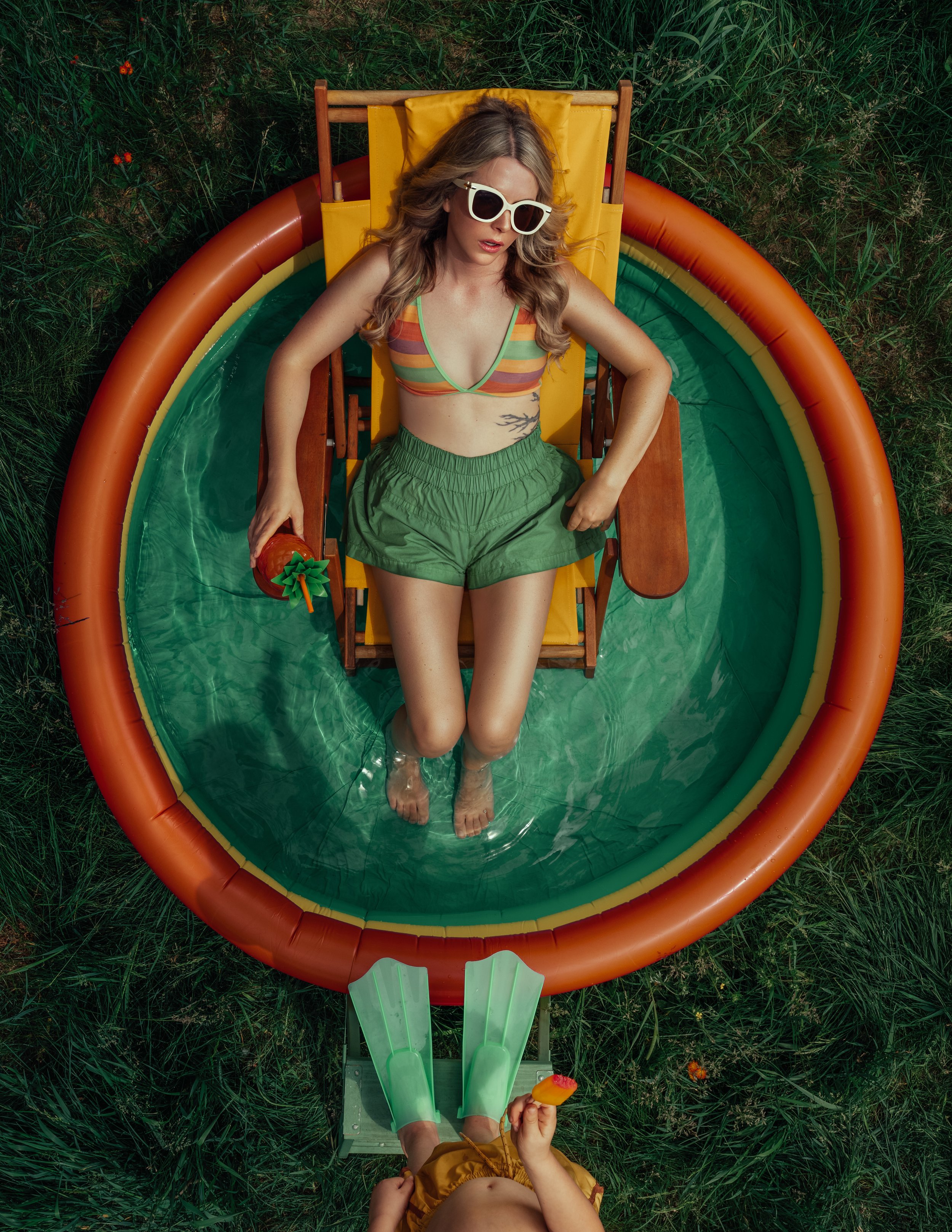
The Art of the Unexpected: Inside Meg Loeks’ carefully constructed world of domestic chaos, cinematic light, and everyday absurdity
Photographs courtesy of Meg Loeks • Interview adapted from her written responses.
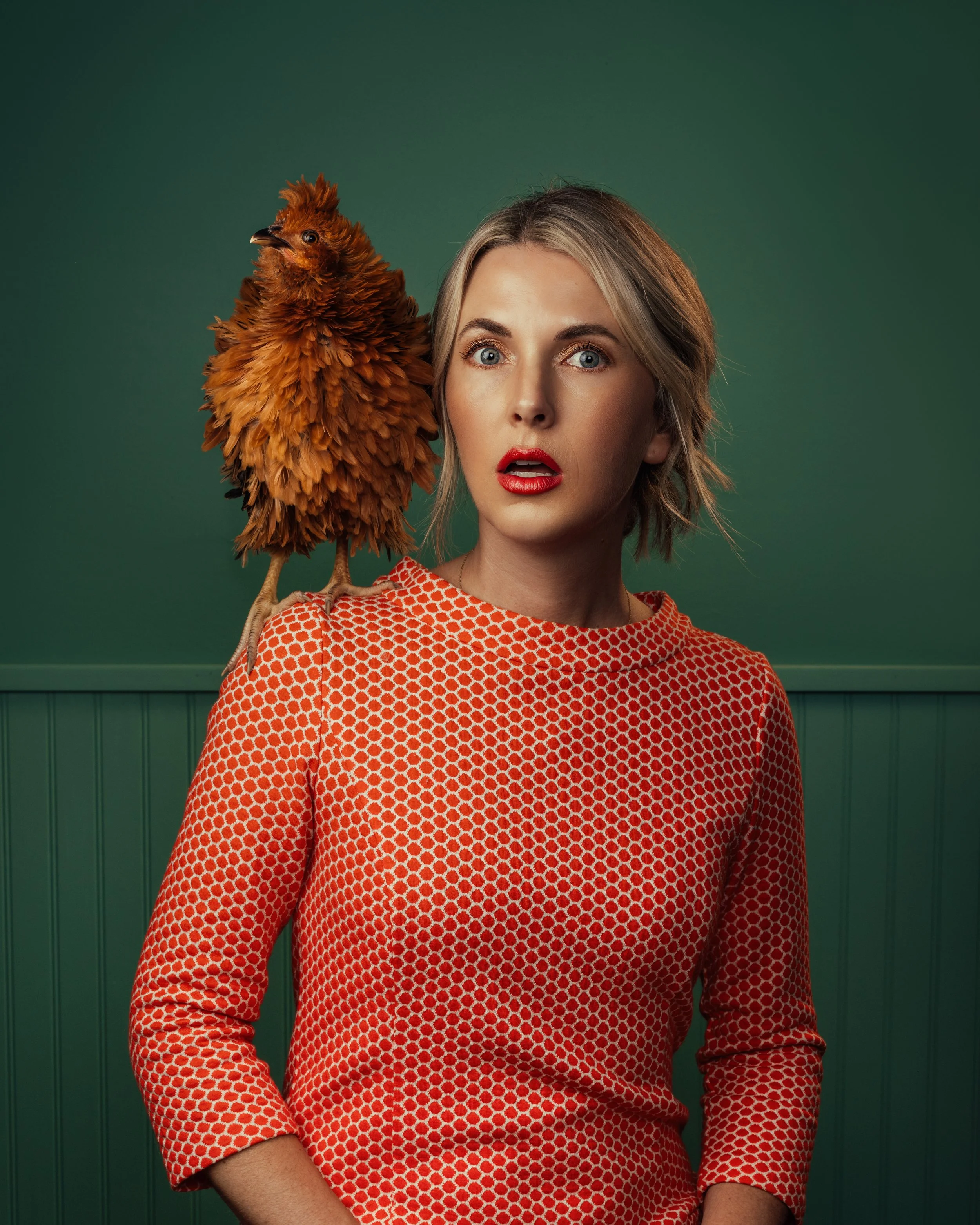
Meg Loeks is an internationally award-winning portrait photographer, educator, and speaker based in Michigan's Upper Peninsula, where she lives on a hobby farm with her husband, five children, and far too many chickens to reasonably explain. Her work has been exhibited internationally and is known for its cinematic use of color, storytelling, and narrative portraiture. With over 12 years of experience teaching workshops and speaking at conferences worldwide, Meg is passionate about helping photographers strengthen their creative vision. She is the founder of Yesteryear Retreats, host of The Creative Thread Podcast, and an ambassador for SIGMA, Profoto, and Imagen. She also volunteers with The Gold Hope Project, photographing families affected by pediatric cancer.
There is something wonderfully unsettling about an ordinary household scene that doesn't behave quite the way we expect it to. A stack of laundry becomes a disappearing act. Familiar objects take on unusual proportions. Domestic routines, so deeply ingrained in daily life that we barely notice them, become elaborate visual narratives filled with humor, tension, and just enough mystery to make us look twice. For photographer Meg Loeks, these contradictions are fertile creative ground.
“I'm interested in the contradictions that exist within everyday life, particularly the expectations surrounding family, domesticity, and tradition,” she explains. “There's often a difference between how life is supposed to look and how it actually feels, and I enjoy exploring that space through photography.”
Her photographs occupy an intriguing space between the familiar and the surreal.
They are meticulously composed, rich in nostalgic color, and illuminated with the precision of cinematic scenes. Yet beneath their carefully constructed appearances are experiences most people recognize: the relentless cycle of household chores, the unpredictability of raising children, and the sometimes absurd expectations attached to family life. Loeks doesn't attempt to conceal those contradictions. She amplifies them.
As a mother of five, she finds no shortage of material in the daily experiences that unfold around her. Rather than looking beyond her immediate surroundings for extraordinary subjects, she often turns her attention to the moments other people might dismiss as mundane, frustrating, or simply part of the routine.
“A lot of my ideas come directly from my own life, particularly the moments that unfold with my five children,” she shares. “I love creating work that reflects the season of life I'm in, and more often than not, that involves a fair amount of chaos.” That chaos is more than an occupational hazard of motherhood. It has become part of her artistic vocabulary.
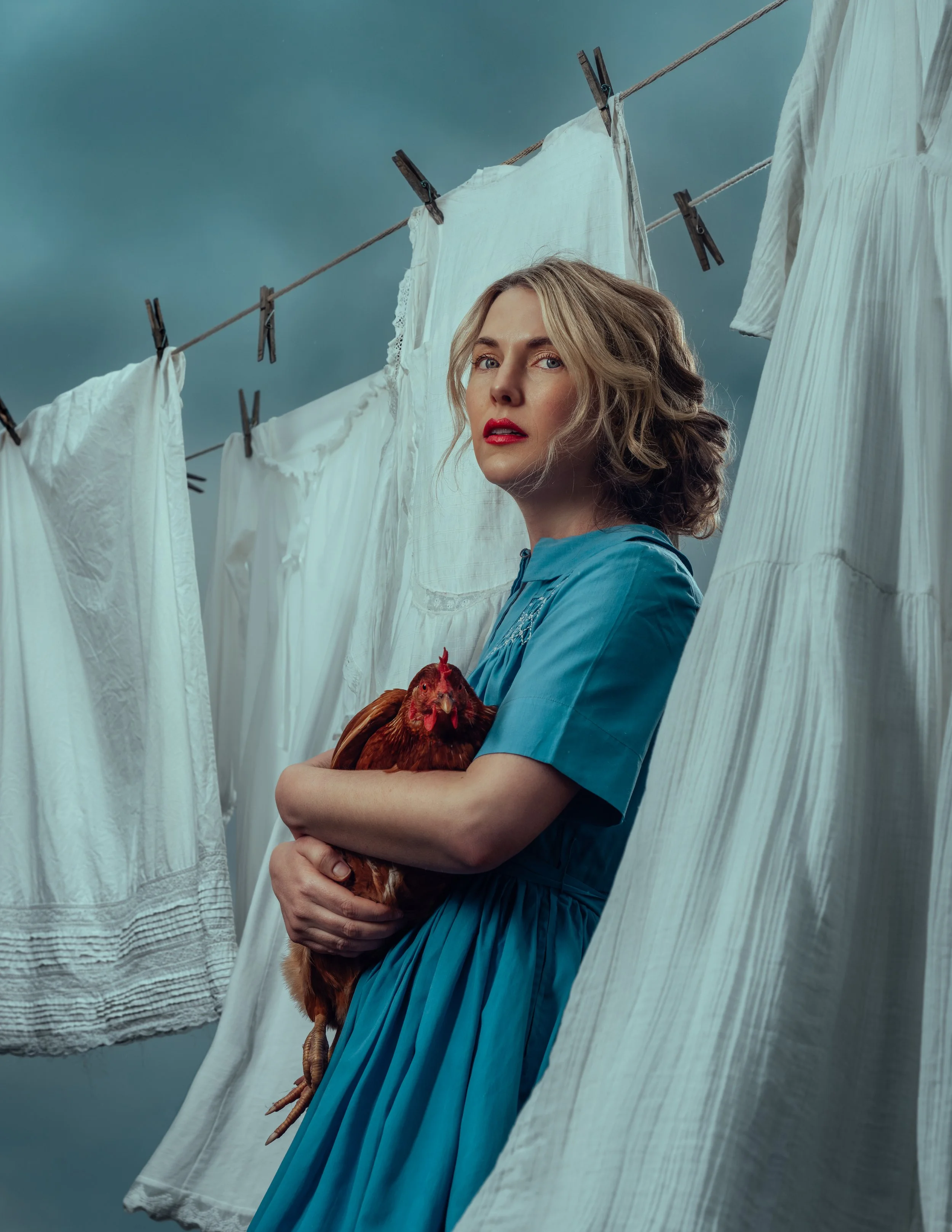
“I also find a lot of inspiration in my own mishaps, frustrations, dislikes, and the things I'm simply not very good at,” she says. “There's something freeing about being able to laugh at yourself, and I enjoy exaggerating those experiences through photography.”
A failed household task or a particularly overwhelming afternoon might not seem like the beginning of a compelling photograph. In Loeks' imagination, however, these moments can become something far more theatrical. Her work challenges the assumption that an interesting photograph requires an extraordinary location or an unusual subject. Sometimes the ingredients for a memorable image have been sitting in the laundry room all along.
One of the defining qualities of Loeks' photography is how easily an ordinary scene can shift into something unexpected. Her images frequently feature recognizable household objects, vintage furnishings, and familiar domestic settings, but their arrangement introduces questions that are not immediately answered.
The effect depends on a delicate balance. Too much familiarity, and the photograph risks becoming purely observational. Too much absurdity, and the emotional connection to everyday experience might disappear.
“I think familiarity is what makes the unusual elements in my work more interesting,” she explains. “When viewers recognize a setting, object, or situation, they already have a connection to it. Introducing something unexpected can shift that familiarity into humor, discomfort, or curiosity.”
Those different reactions are not competing interpretations. They are all welcome.
“I don't necessarily want everyone to interpret an image the same way,” Loeks says. “Some viewers might find a photograph funny, while others recognize something more personal beneath the humor. I like creating work that allows both responses to exist.”
This openness extends to the visual information she chooses to withhold. A hidden face, an unresolved gesture, or an object appearing somewhere it doesn't belong can suggest an entire story without revealing its conclusion.
Rather than supplying an explanation, Loeks creates space for the viewer to participate.
“I want viewers to bring their own experiences to the photograph,” she explains. “The mystery gives them room to interpret the story, while the familiar setting or emotion gives them something to connect with.”
Even the objects themselves carry meaning. Household belongings and vintage furnishings can evoke family traditions, expectations, identity, or nostalgia before they are placed into a more unusual narrative.
But those associations are only part of what makes an object useful to her. Its texture, silhouette, color, and relationship to the surrounding environment are equally important considerations. A prop must contribute visually as well as conceptually.
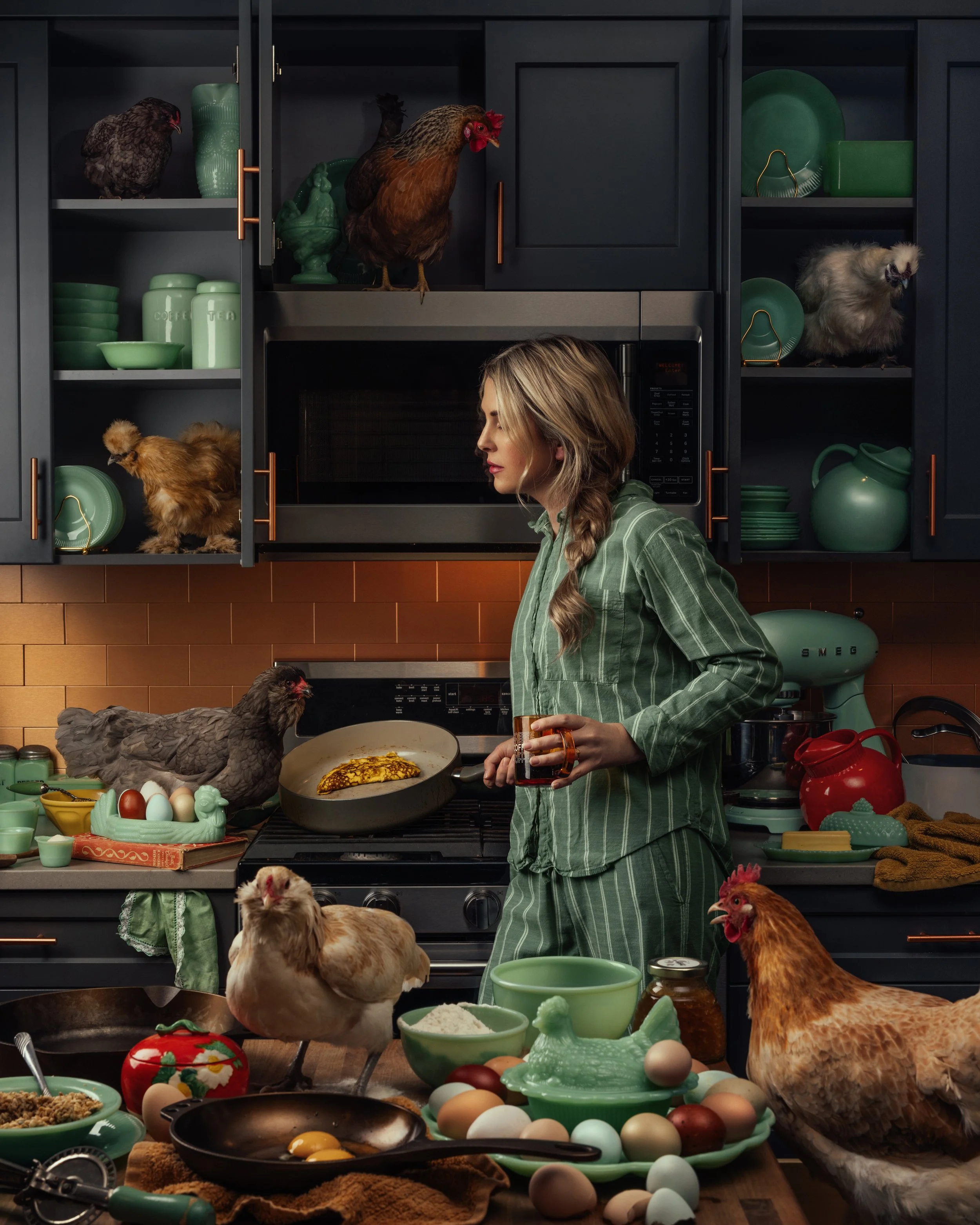
The result is photography that rewards prolonged observation. What initially appears to be an amusing visual trick may reveal a more complicated relationship with domestic expectations. An apparently nostalgic scene might carry a subtle sense of unease. Loeks is content to leave those possibilities unresolved.
Despite the spontaneity of the experiences that inspire her, Loeks' finished photographs are anything but accidental. Her process involves constructing an environment in which every element has a purpose. Wardrobe, props, composition, lighting, and color must work together to support the narrative, even when that narrative deliberately leaves room for interpretation. The initial spark can come from almost anywhere.
“Sometimes an idea begins with a familiar saying or an experience I want to interpret visually,” she explains. “Other times I'm inspired by an object, a location, an interesting color combination, or the way light falls across a room.”
Once a concept begins taking shape, she considers how its individual components will interact. The relationship between colors might establish the mood, while a carefully positioned object creates tension or draws attention to an otherwise overlooked detail. Yet meticulous planning doesn't mean every decision is predetermined.
An idea that works perfectly in her imagination may not have the same effect once viewed through the camera. Loeks treats those moments as opportunities to experiment rather than reasons to abandon the photograph.
“I've learned that being committed to an idea doesn't mean being committed to every detail of the original plan,” she says. It is a distinction that reveals much about her approach. She can be exacting about the finished image without becoming inflexible about how she arrives there.
Sometimes the smallest adjustment changes everything: shifting the camera angle, repositioning an object, or allowing an unexpected interaction between elements to influence the composition.
That willingness to revise is especially important in photographs containing numerous visual details. Loeks gravitates toward maximalism, but she is keenly aware that an abundance of objects can overwhelm a frame without careful organization. Lighting is central to maintaining that balance.
“Light is one of my most important storytelling tools,” she explains. “It influences where the viewer looks, how the environment feels, and which elements become significant within the frame.” She frequently works with multiple strobes, favoring smaller softboxes for the precision they provide. Colored gels allow her to create subtle shifts in atmosphere, while carefully layered light establishes depth and separates subjects from their surroundings. Rather than illuminating everything evenly, she uses light to determine what deserves attention.
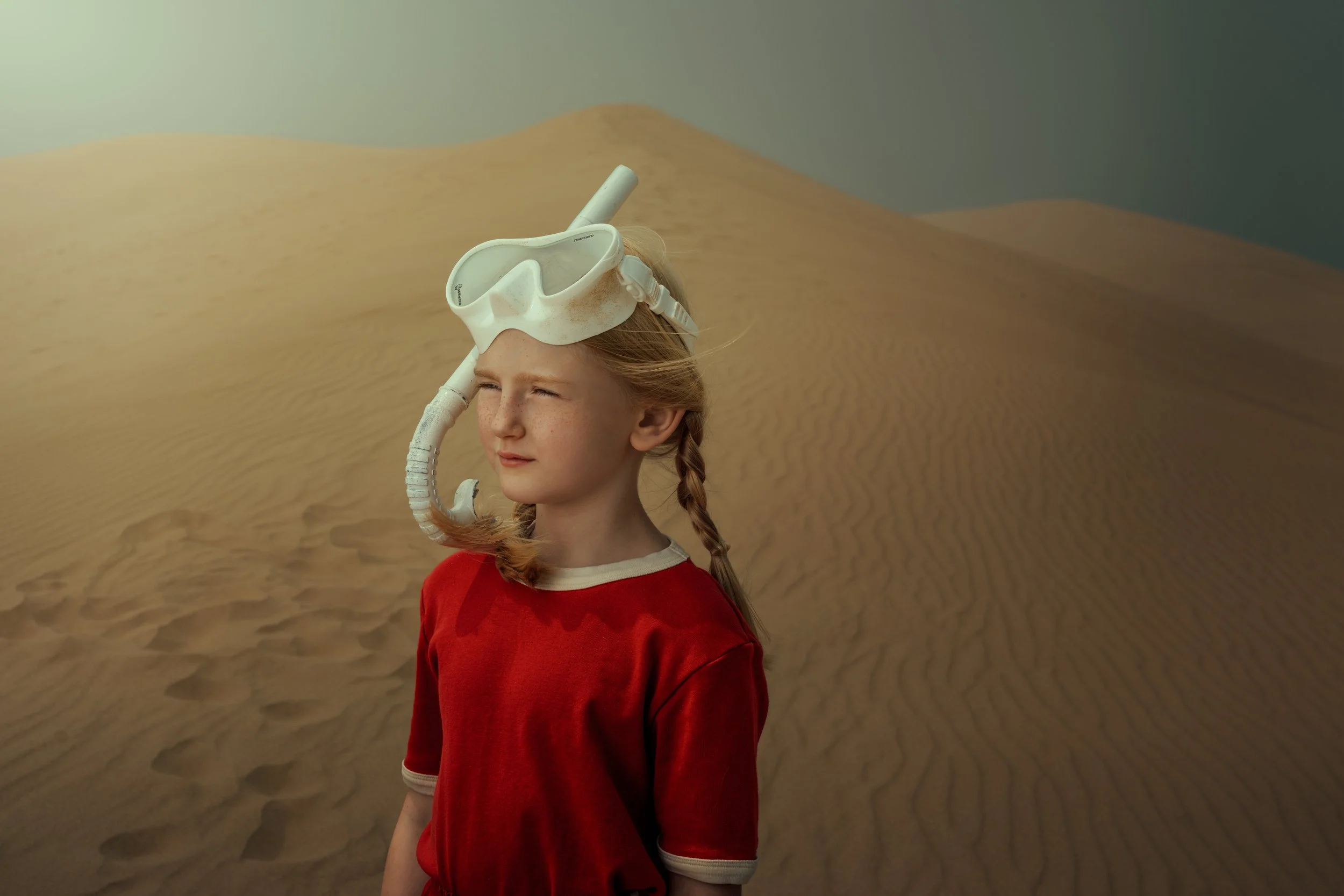
“I'm equally interested in what shadows can suggest as I am in what the light reveals,” she says. “I don't believe every part of a photograph needs to be equally visible, and sometimes allowing details to fall into shadow adds to the mystery.” Although her lighting arrangements can be technically elaborate, the objective is rarely to draw attention to the equipment or technique. Instead, she wants the illumination to belong convincingly within the world she has constructed. Color serves a similarly intentional purpose.
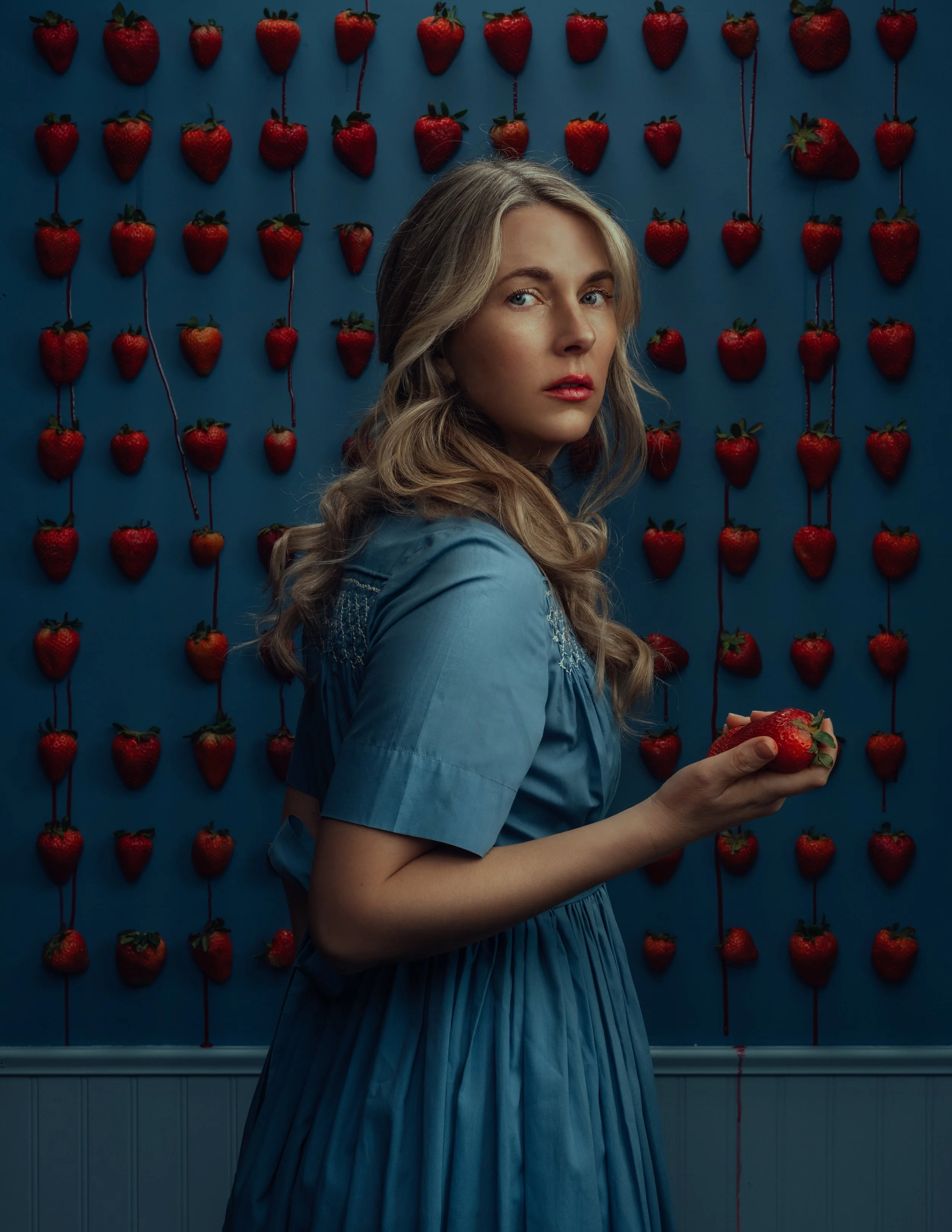
Loeks is particularly attracted to nostalgic palettes incorporating deep greens, blues, warm yellows, and vibrant touches of red or pink. These colors often evoke a distinctly Americana-inspired atmosphere, although unexpected combinations can make a familiar environment feel subtly out of place.
“Color can communicate something before a viewer has even begun interpreting the narrative,” she explains. “It can create a sense of warmth, nostalgia, discomfort, or contradiction, depending on how it's used.” In her photographs, color and light do more than create an aesthetic. They establish the conditions under which the story is experienced.
Few photographs illustrate Loeks' approach more clearly than her recent self-portrait, Pressing Matters: Buried in the Folds. Its inspiration was decidedly unglamorous: her dislike of ironing.
“My recent self-portrait, Pressing Matters: Buried in the Folds, was inspired by something I genuinely dislike: ironing and laundry in general,” she explains. “I wanted to take that frustration and make it a little dramatic and uncanny, but still believable.”
The resulting scene transforms an ordinary household chore into a visual illusion. Loeks appears slumped over an ironing board, her head hidden behind a stack of folded laundry. From the camera's perspective, she seems almost headless. The effect is striking precisely because of its simplicity.
Rather than relying on elaborate manipulation, Loeks used perspective and positioning to create the illusion. The camera records an arrangement that is physically straightforward but visually perplexing.
“I loved that the illusion could be created through positioning rather than an elaborate effect,” she says. Once she established the composition, Loeks turned to the surrounding palette. The dusty blue wall of her studio provided the foundation, and a vintage pink blouse and skirt discovered at a local antique shop introduced contrast.
Buttercream and mustard-colored laundry added further dimension, preventing the photograph from relying too heavily on the relationship between pink and blue. The lighting required its own improvisation.
Working within a relatively tight space, Loeks positioned her key light outside a window. A second light bounced off the ceiling to provide fill, while a third, placed outside a glass door, backlit both her figure and the stack of laundry.
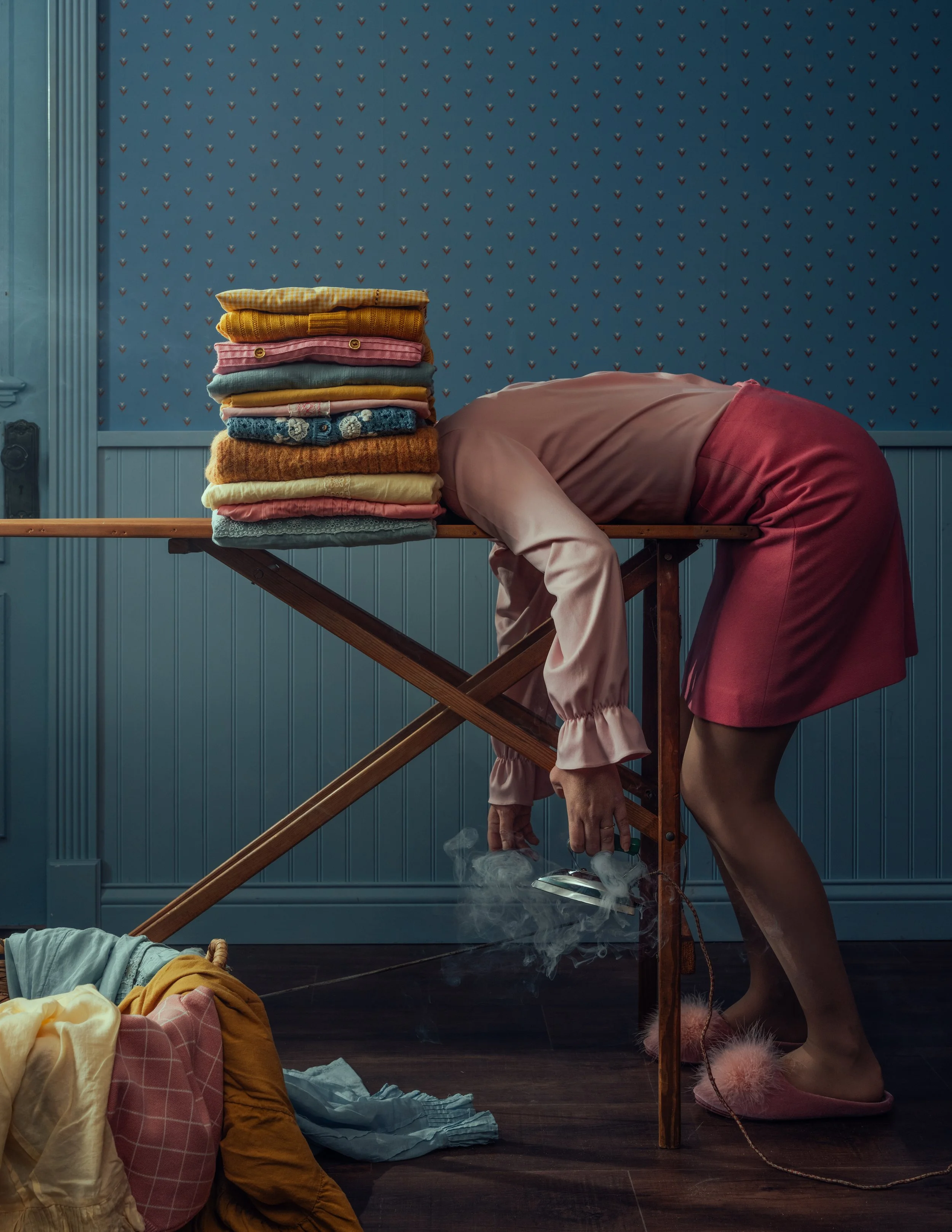
The arrangement helped separate the different elements, emphasize the textures of the clothing, and create the dimensional quality that characterizes much of her work. Although the finished image feels theatrical, its construction demonstrates how much can be achieved through observation, positioning, and technical problem-solving.
“There's nothing particularly complicated about the pose, but the perspective, lighting, and carefully arranged details make the situation feel just strange enough to warrant a second look,” Loeks explains.
The photograph also illustrates her reluctance to define every possible meaning behind an image.
At first glance, Pressing Matters might simply be a humorous exaggeration of an unpleasant household task. But its disappearing subject and imposing stack of laundry also leave room for viewers to consider what it means to feel consumed by ordinary responsibilities. Loeks does not insist on a particular interpretation.
“There are often underlying meanings in my work that I intentionally leave unexplained,” she says. “While an image might begin with something humorous or seemingly trivial, there can be more beneath the surface.” For her, the viewer's response is part of the experience, not a question that needs a definitive answer.
For photographers interested in creating more conceptual work, Loeks offers an accessible starting point: look closely at what is already around you.
An ordinary activity, a familiar object, or a repetitive household task can become the foundation for something visually unexpected. The transformation doesn't necessarily require complicated equipment or an elaborate set. It begins with imagination.
“I'd encourage photographers to choose an ordinary object or activity from their daily routine and think about how they could transform it into something unexpected,” she says.
One technique she frequently uses involves exaggerating the scale or quantity of familiar objects. An everyday item becomes uncanny when it appears unusually large or is duplicated excessively within a scene.
Perspective can accomplish something similar. Concealing a subject, altering the expected relationship between objects, or exaggerating a recognizable action can introduce mystery without requiring a complicated production. These techniques are effective because they challenge what viewers assume they already understand.
These techniques are effective because they challenge what viewers assume they already understand. Loeks also emphasizes the importance of observing a scene before beginning to photograph it. Light, color, and the relationships between ordinary objects can suggest possibilities that might otherwise go unnoticed.
“You don't need elaborate sets or expensive props,” she explains. “Sometimes all it takes is looking at something you've seen a thousand times and imagining it a little differently.” That philosophy runs throughout her work.
The most interesting element of a Meg Loeks photograph is not necessarily the illusion itself, nor the intricate lighting or carefully coordinated vintage wardrobe. It is the connection between a highly constructed image and the thoroughly ordinary experience that inspired it.
Laundry remains laundry. Household expectations remain familiar. The chaos of raising a family doesn't disappear simply because it has been transformed into a cinematic photograph. Instead, Loeks gives those experiences another form.
Her images invite viewers to reconsider the things they encounter so frequently that they have stopped paying attention to them. There is humor in the repetition, absurdity in the expectations, and sometimes a more complicated emotion hiding just beyond what the camera reveals. And somewhere between the ordinary and the impossible, a familiar scene becomes a story worth looking at again.
Connect with Meg
Website: www.megloeks.com • Instagram: @meg_nlo