Learning to See Yourself Through Your Own Lens
There’s always that one self-portrait we avoid taking—the one that feels a little too honest. Not the posed version you take because you “need a new profile picture,” and not the quick test shot you grab while adjusting your settings. I mean the real one. The one that forces you to stop, breathe, and look at yourself the way you look at everyone else you photograph: with curiosity, softness, and truth.
Photographers are experts at capturing other people’s beauty, emotion, and stories… but turning the camera on ourselves? That hits differently. It feels vulnerable in a way that even we can’t quite articulate. Maybe because we know the tricks, the angles, the ways to hide. Maybe because we spend so much time behind the lens that the idea of stepping in front of it feels uncomfortably intimate.
But here’s the secret:
Your self-portrait isn’t actually about how you look. It’s about how you’re living.
It’s a timestamp of your growth, your exhaustion, your resilience, your softness, your edge. It’s a conversation with the version of you who’s been carrying more than anyone realizes. And most importantly—it’s a chance to see yourself with the same compassion you so effortlessly give to others.
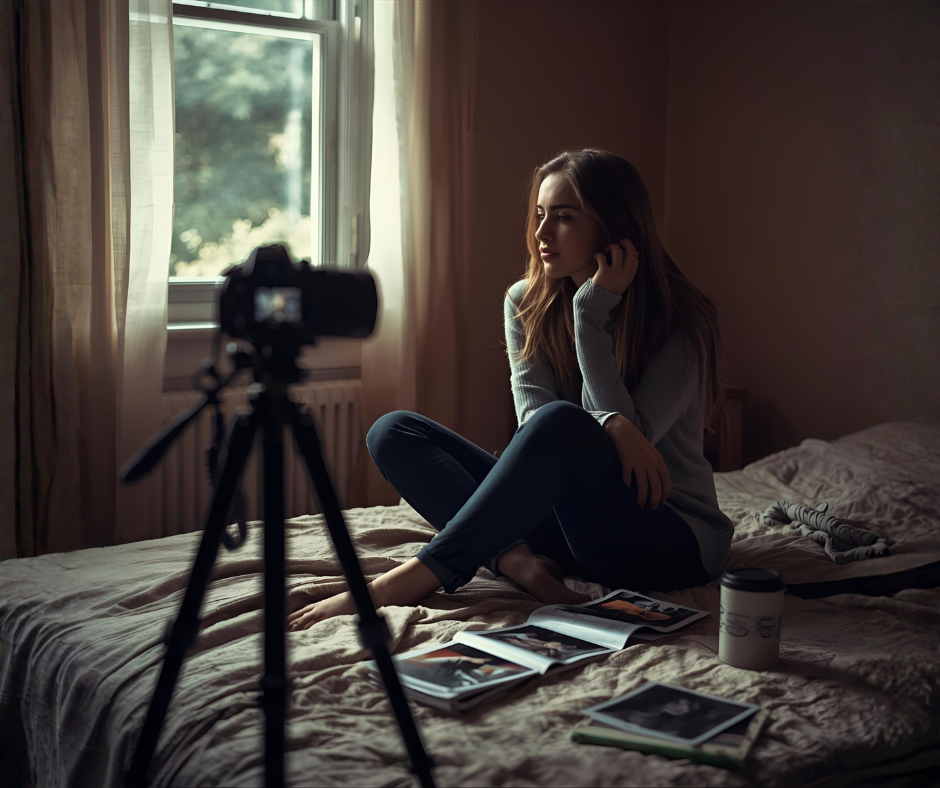
The Exercise: A Self-Portrait You Can Actually Do
You don’t need a studio. You don’t need perfect lighting. You just need an hour, your camera, and the courage to be honest.
1. Set the scene where you actually live your life.
Not the Pinterest-ready part—your real space.
The bed you collapse into at midnight.
The desk covered in receipts and coffee.
The kitchen floor where your kid dropped cereal this morning.
Wherever you’re currently existing… that’s your backdrop.
2. Choose ONE emotion you’ve been avoiding.
Not what you want to feel—what you are feeling.
Tired.
Hopeful.
Healing.
Lonely.
Proud.
In the middle of figuring it all out.
Let that emotion lead the shot.
3. Set up your camera and walk away.
Give yourself distance.
Give yourself space to breathe.
Use a timer or remote and let the shots happen without micromanaging.
4. Don’t pose—exist.
Sit how you naturally sit.
Hold your coffee.
Look out the window.
Rest your face.
Sink into your body.
This isn’t about looking flattering.
It’s about looking real.
5. After shooting, don’t delete anything.
Not yet.
Let them sit.
Come back tomorrow with fresh eyes and a softer heart.
The Reflection: What Do You See?
When you revisit the images, don’t critique. Observe.
Where do you look tired?
Where do you look strong?
Where do you look softer than you thought you were?
Where do you look like someone who has survived things without telling the whole world about them?
Where do you look like someone worthy of gentleness?
Photographers often mistake their self-portraits for mirrors. But they’re not mirrors—they’re windows. They show not just how you look, but where you are in your story.
This exercise isn’t about capturing your “best side.”
It’s about acknowledging every side: the growing version, the grieving version, the rebuilding version, the brave version who picked up the camera to witness herself—finally.
Because here’s the truth:
You deserve to be seen by you.
Not the polished you.
Not the everything’s-fine you.
You—as you are in this moment.
Flawed, brilliant, human, evolving.
Your self-portrait isn’t a vanity project.
It’s a love letter to the person you’re becoming.